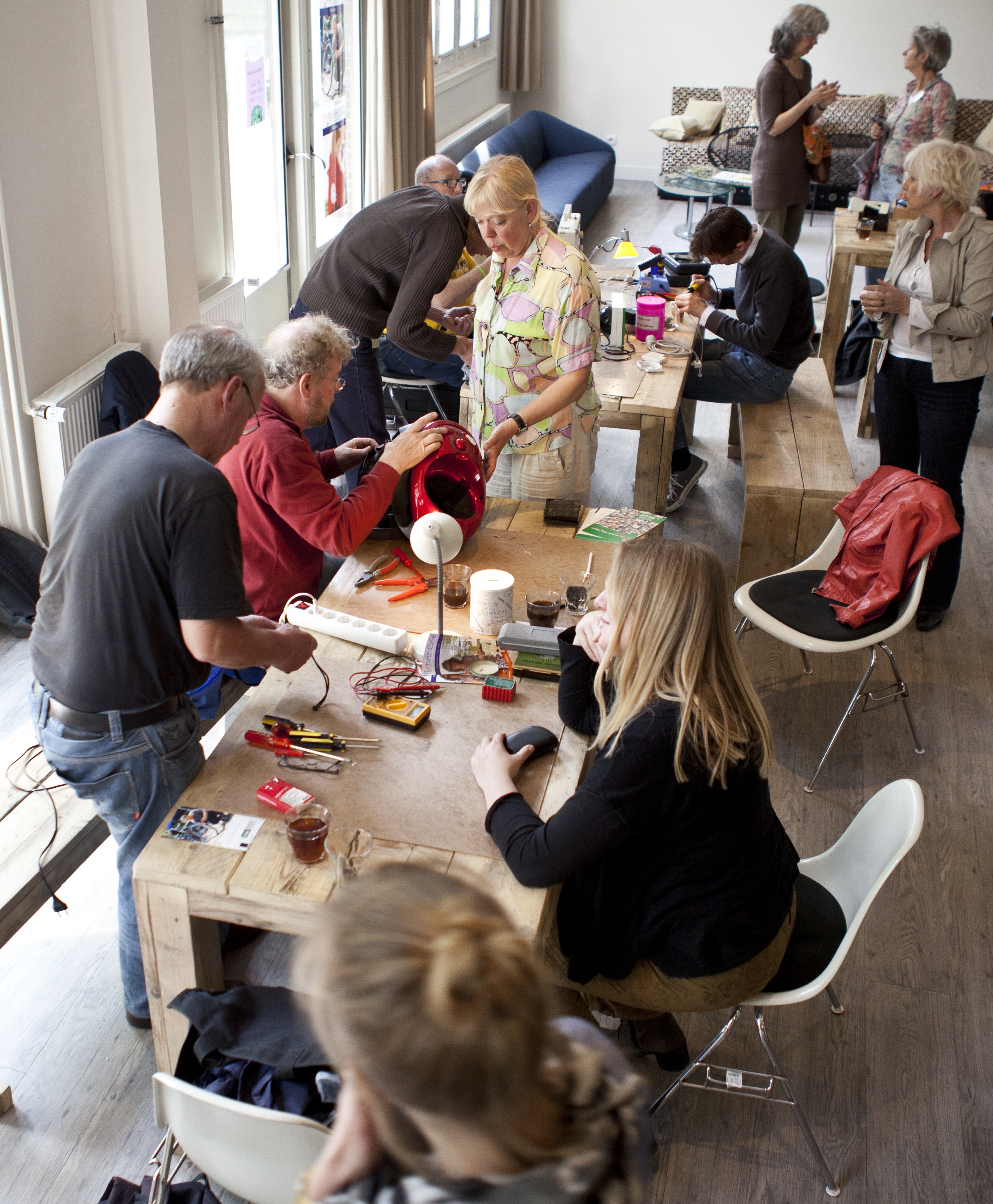
The repair gap: what gets thrown away that could be fixed
The term "repair gap" refers to the difference between what could theoretically be repaired and what actually is. Research from the European Environment Agency, which is broadly applicable to Canadian conditions, estimates that 48–80% of small household appliances discarded in residential waste streams are in repairable condition at the time of disposal. The gap exists because repair is perceived as too time-consuming, too expensive, or beyond the householder's skill set — not because the item is irreparable.
Community skill-sharing addresses the third of those barriers directly. When there is a local knowledge resource — a neighbour who can re-sole shoes, a volunteer who can reseat a loose chair joint, a repair cafe with a working soldering station — items that would otherwise be discarded enter a different decision-making context.
Skills that reduce waste the most per instance
Not all skills have equal impact on waste volumes. Measured by weight diverted per repair and by the frequency of items in residential waste streams, the highest-impact skills documented in Canadian community repair contexts are:
Textile and clothing repair
By volume, clothing and textiles represent a significant fraction of residential waste in Canada. Statistics Canada's 2018 waste characterisation study identified textiles as approximately 5.4% of residential solid waste by weight in Ontario. A garment discarded because of a broken zip or a tear along a seam weighs between 200g and 2kg — and the repair, if the skill is available, takes 10 to 20 minutes. At scale, textile repair events have a high waste-diversion-to-volunteer-hour ratio.
Small appliance repair
A broken toaster, kettle, or coffee maker typically weighs 0.5 to 2.5 kg. The failure modes most commonly encountered at repair events — a broken heating element, a faulty switch, a worn cable — are addressable with basic electronic knowledge and access to a multimeter. The limiting factor is parts: for appliances manufactured after 2015, replacement components are often unavailable or priced at 60–80% of the cost of a new unit, which changes the repair calculus.
Bicycle maintenance
A functional bicycle kept in service displaces both a vehicle trip and a potential disposal. Bicycle repair at the community level — puncture repair, cable replacement, brake adjustment — is one of the more transferable skills because it requires no specialist equipment beyond basic tools and is applicable to a large number of items. The skill propagates quickly: people who learn to repair a puncture at a repair event typically apply that knowledge independently afterward.
Wooden furniture repair
Furniture diversion is high-value by weight but occurs less frequently. A wooden chair discarded because of a loose joint weighs 2–5 kg and the repair requires wood glue, a clamp, and 20 minutes. The knowledge barrier is low, but access to the right adhesive and clamp size prevents most people from attempting the repair at home. A community workspace with these materials on hand changes that.
How skill-sharing differs from individual repair
Individual repair — a person fixing their own item — produces a single waste-diversion event. Skill-sharing produces a secondary effect: the person who watches a repair being performed, or receives brief instruction during the repair, acquires some portion of that knowledge and may apply it independently in the future.
This secondary effect is difficult to quantify but is cited consistently by repair event organisers as one of the reasons they consider the events valuable beyond the directly measurable repair count. A 2022 study from the University of Waterloo examining repair cafe participants in Ontario found that 41% of attendees who observed a repair reported attempting a similar repair themselves within six months.
Documenting skills before they are lost
A recurring concern in the Canadian repair community is the loss of practical repair knowledge as the tradespeople and craft practitioners who hold it age out of volunteer availability. Many of the most skilled repair cafe volunteers — retired appliance technicians, tailors who trained in an era before fast fashion, furniture makers from manufacturing-era industries — are in their 60s, 70s, or 80s.
Several Canadian community organisations have begun structured documentation efforts: recording short instructional videos during repair events, writing step-by-step guides to common repairs, and archiving the tacit knowledge of experienced volunteers in formats that can be shared with newcomers. These efforts are modest in scale but represent a recognition that the skill itself is as worth preserving as any individual repaired item.
The iFixit platform — which hosts community-contributed repair manuals for consumer products — is used by several Canadian repair organisers as both a reference and a documentation target. Several repair cafes have contributed Canadian-specific guides to the platform's database.

What the numbers actually show
The Repair Café Foundation publishes aggregate data from registered events globally. In 2023, it reported that registered events collectively repaired over 420,000 items, with a 58% full repair success rate. Canadian events contributing to that database are a small fraction of the total, but the success rate is consistent with what Canadian organisers report independently.
Extrapolating from event-level data — approximately 60 documented regular repair events in Canada in 2025, each running 10–12 sessions annually with an average of 30 items per session — produces a rough estimate of 18,000 to 22,000 items repaired annually at community events across the country. At an average weight of 1.2 kg per item, that is approximately 21–26 tonnes per year.
That figure is small relative to Canada's total residential waste generation of roughly 26 million tonnes annually. It represents, however, a dense and disproportionately valuable slice of that waste stream: the items with the highest embodied energy per kilogram (electronics), the highest social cost per unit (clothing with sentimental value), and the highest per-repair weight offset (furniture). The case for community repair is not that it solves the waste problem at scale — it is that it addresses the part of the problem that no other intervention reaches efficiently.
The connection to tool-sharing
Skill-sharing and tool-sharing address related but distinct barriers. Skill-sharing lowers the knowledge threshold for repair; tool-sharing lowers the equipment threshold. Both are necessary for the same reason: most households lack both the knowledge and the tools to repair most categories of household goods independently.
The communities where both infrastructure elements coexist — a tool library and a regular repair event — show compounding effects that neither produces alone. A borrower who brings a tile saw home from a tool library to re-grout a bathroom may also, at a repair cafe, learn to re-caulk a sink that would otherwise have been replaced. These interactions build a local culture of maintenance that persists beyond any single event or organisation.
For the statistical baseline on Canadian household waste, the Statistics Canada Environment division publishes waste characterisation surveys updated periodically with provincial breakdowns.